
YouTube remains one of the most important video platforms in the world, and AI-generated content is not automatically excluded from monetization.
What matters increasingly is whether the content is original, authentic and genuinely useful or entertaining rather than repetitive or mass-produced. YouTube specifically identifies generic, repetitive and template-driven AI content as a potential monetization problem, while materially different stories, educational content and original creative work can still qualify. Google Help
For serious AI creators, however, the bigger question is no longer simply:
“Can I monetize AI videos on YouTube?”
It is:
“Should YouTube be my only platform?”
Probably not.
AI creators now have several ways to distribute their work, build audiences and generate revenue beyond traditional advertising.
Some platforms are optimized for viral discovery. Others help creators build personal brands. Some provide traditional video monetization, while emerging AI-focused ecosystems can connect creation, publishing and monetization more directly.
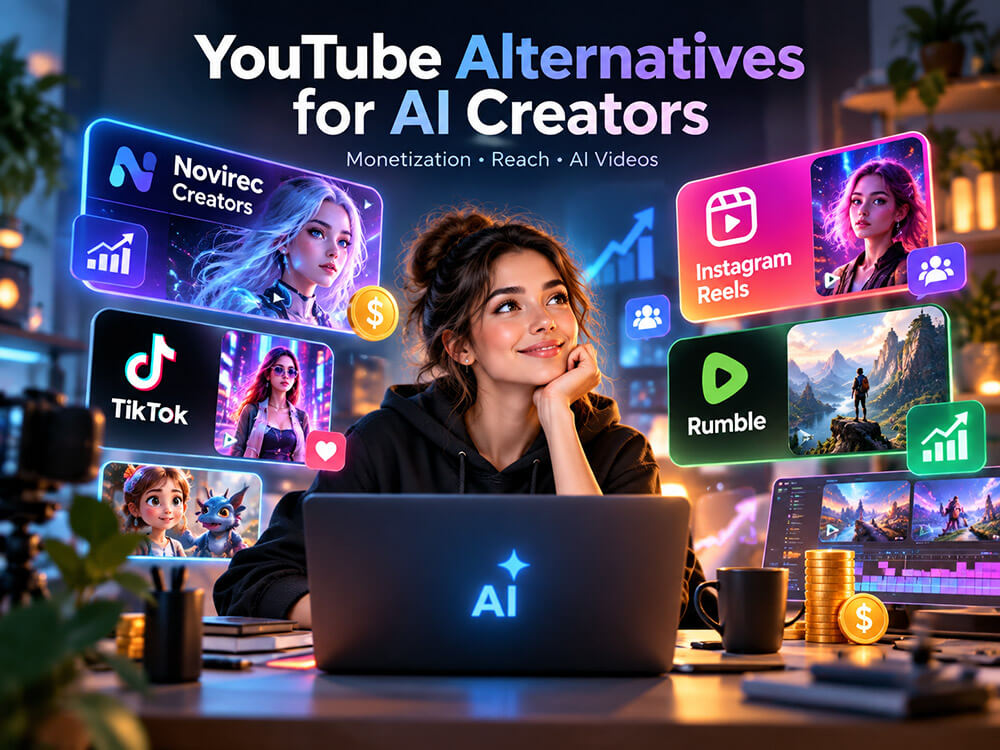
Here are four of the most relevant YouTube alternatives for AI creators in 2026 — and, more importantly, the different ways they can help creators make money.
Why AI Creators Are Looking Beyond YouTube
YouTube has enormous reach, but that scale also creates enormous competition.
An AI filmmaker publishing a short cinematic story is competing with gaming channels, podcasts, news networks, music videos, tutorials, entertainment companies and millions of other creators.
That does not make YouTube a bad platform.
It makes platform diversification increasingly valuable.
More opportunities for discovery
Different recommendation systems expose content to different audiences.
A video that receives little attention on one platform can perform extremely well somewhere else.
AI content is particularly suited to this because visually striking scenes, unusual characters and short cinematic concepts can work very well in recommendation-driven feeds.
More than one source of revenue
Depending entirely on one advertising program creates a fragile creator business.
Modern creators can combine:
- platform revenue sharing;
- direct fan support;
- affiliate commissions;
- sponsorships;
- subscriptions;
- paid content;
- digital products;
- licensing;
- brand partnerships.
A creator does not necessarily need millions of views if several smaller revenue streams work together.
Access to specialized audiences
There is also a difference between reaching a large audience and reaching the right audience.
General platforms contain almost every imaginable content category.
An AI-focused environment can instead attract users who are already interested in generative video, AI art, storytelling, animation and emerging creative technologies.
For some creators, that audience can be considerably more valuable.
Quick Comparison: Best YouTube Alternatives for AI Creators
| Platform | Best For | AI-Focused | Main Monetization Opportunity | Main Advantage |
|---|---|---|---|---|
| Novirec Creators | AI-native creators | Yes | Creator revenue, support & affiliate ecosystem | Creation + publishing + AI audience |
| TikTok | Viral short-form discovery | No | Platform programs, sponsorships & affiliates | Massive discovery potential |
| Instagram Reels | Personal brands & visual creators | No | Gifts, subscriptions, sponsors & affiliates | Brand-building ecosystem |
| Rumble | Alternative video distribution | No | Creator program & video monetization | Diversified video revenue |
1. Novirec Creators — Best for AI-Native Creators
Best for: AI storytellers, AI filmmakers, generative artists and creators who want creation, publishing and monetization inside the same broader ecosystem.
Most YouTube alternatives were built as general-purpose social or video platforms.
Novirec approaches the problem from the opposite direction.
The ecosystem is built around AI creation itself.
That makes Novirec Creators particularly relevant for people creating:
- AI story videos;
- cinematic sequences;
- recurring AI characters;
- animated shorts;
- AI artwork;
- visual storytelling;
- experimental generative films;
- image-to-video content.
Instead of simply uploading an AI video to a general platform, creators can participate in an environment where AI-generated media is part of the platform’s core identity.
From creation to publishing
One of the biggest differences is that Novirec is not only a distribution platform.
Creators can also produce content within the wider Novirec ecosystem.
That creates a more connected journey:
Create → refine → publish → build an audience → monetize
For creators already using AI generation tools, reducing the number of disconnected services in that workflow can be valuable.
Public creator presence
Creators can publish AI-generated images and videos through Novirec’s creator ecosystem and build a public portfolio around their work.
That creates opportunities to showcase more than isolated videos.
A creator can develop an identity around:
- recurring characters;
- a visual universe;
- story series;
- image collections;
- cinematic styles;
- experimental concepts.
This matters because sustainable creator businesses are often built around an audience following the creator, not merely one viral video.
Novirec Creator monetization
Novirec is also designed to connect creator activity with several monetization mechanisms.
Depending on the relevant program and eligibility, the ecosystem can include revenue associated with creator content, direct audience support and affiliate activity.
That means the creator opportunity is broader than simply earning advertising revenue on individual video views.
A creator could potentially combine:
Creator revenue
Earnings generated through participation in the Novirec creator ecosystem.
Direct support
Fans can financially support creators they enjoy.
Affiliate commissions
Creators participating in Novirec’s affiliate program can earn commissions from referred customers.
This creates an interesting distinction.
On many platforms:
Publish video → accumulate views → hope advertising generates enough revenue.
Within a broader AI creator ecosystem, the model can become:
Create → publish → attract users → build audience → generate several forms of revenue.
Who should consider Novirec?
Novirec makes the most sense for creators whose content is genuinely centered around generative AI.
It does not need to replace YouTube.
It can become another layer of an AI creator’s distribution and monetization strategy.
Best choice for: AI-native creators who want their creation tools, public portfolio and monetization opportunities to exist within the same ecosystem.
Publish and monetize your AI creations with Novirec Creators.
2. TikTok — Best for Viral AI Video Discovery
Best for: short AI videos, visually surprising concepts and creators prioritizing rapid audience discovery.
TikTok’s greatest advantage is not traditional video hosting.
It is its recommendation engine.
A relatively unknown creator can potentially receive significant distribution without already having a large subscriber base.
That makes TikTok particularly well suited to visually immediate AI content.
Examples include:
- character transformations;
- cinematic AI shots;
- surreal environments;
- micro-stories;
- before-and-after generations;
- talking characters;
- AI fashion;
- visual experiments.
TikTok monetization
TikTok monetization should not be viewed as one single revenue source.
Creators can potentially combine several approaches depending on account, region and eligibility.
Platform creator programs
TikTok has offered direct creator monetization programs in eligible markets.
Availability, requirements and program structures can change, so creators should check the conditions applicable to their account and country before treating platform payouts as a predictable business model.
Affiliate marketing
This can be particularly interesting for AI creators.
Someone producing tutorials, comparisons or behind-the-scenes content can recommend:
- AI generators;
- editing software;
- creative tools;
- hardware;
- subscriptions;
- workflow services.
Affiliate commissions can sometimes become more important than direct platform payouts because they monetize purchase intent, not simply views.
Sponsorships
AI creators can also attract companies trying to reach audiences interested in generative technology.
Possible sponsorship formats include:
- demonstrating an AI product;
- creating a sponsored video;
- integrating a tool into a workflow;
- producing a branded AI sequence;
- reviewing a creator service.
A specialized audience can be attractive even when the creator does not have millions of followers.
Traffic to external revenue
TikTok can also function primarily as an acquisition channel.
Short videos can send viewers toward:
- another creator profile;
- a paid community;
- an affiliate page;
- a portfolio;
- a product;
- a longer story;
- another publishing platform.
That means the financial value of a TikTok video may exceed its direct platform payout.
The limitation
TikTok remains fundamentally a fast-moving feed.
That is excellent for discovery but less ideal for building a structured catalogue of interconnected AI stories.
Creators should therefore think of TikTok as a distribution engine, not necessarily as the permanent home of all their work.
Best choice for: AI creators prioritizing reach and short-form discovery.
3. Instagram Reels — Best for Building an AI Creator Brand
Best for: creators combining AI video, imagery, personal branding and commercial partnerships.
Instagram occupies an interesting middle ground.
It provides short-form video discovery through Reels, but a creator profile can also contain images, Stories, carousels and other content.
For AI creators, that means a single project can become several publications.
For example:
Reel: final AI animation
Carousel: character designs
Story: production process
Image post: hero frame
Behind-the-scenes: prompts or workflow insights
That makes Instagram particularly effective for turning creative work into a recognizable brand.
Instagram monetization
Instagram offers several forms of monetization, although availability can depend on eligibility, account and region.
Meta’s current payout documentation identifies monetization products including Gifts and Subscriptions. Instagram Help Center
But direct Instagram payouts are only one part of the opportunity.
Gifts
Viewers may be able to financially support eligible creators through Gifts.
This turns audience engagement into a more direct form of creator support.
Subscriptions
Eligible creators can use subscriptions to offer premium access to their most engaged followers.
For AI creators, subscription content could include:
- exclusive videos;
- early releases;
- behind-the-scenes material;
- tutorials;
- private posts;
- production breakdowns.
Sponsorships and brand partnerships
For many established Instagram creators, brand relationships can be more strategically important than platform payouts.
AI creators occupy an attractive niche because software companies, creative tools and technology brands often want to reach exactly this audience.
Potential collaborations include:
- sponsored Reels;
- tool demonstrations;
- branded generated imagery;
- AI campaign content;
- creator partnerships.
Affiliate marketing
Instagram can also work extremely well as a visual affiliate marketing channel.
A creator can demonstrate a product rather than merely linking to it.
For example, an AI filmmaker could show the result of an animation workflow and direct interested viewers toward the tools involved.
Why Instagram works differently from TikTok
TikTok is heavily optimized around individual pieces of content.
Instagram can place more emphasis on the identity surrounding that content.
That is valuable for creators who want people to remember their visual style, characters or creative universe.
Best choice for: AI creators interested in personal branding, partnerships and diversified monetization.
4. Rumble — Best for Diversifying Traditional Video Revenue
Best for: creators who want an additional video platform with direct monetization opportunities.
Rumble is closer to a traditional YouTube alternative than TikTok or Instagram.
Creators can distribute longer video content and participate in monetization systems without relying entirely on YouTube.
Its 2026 Creator Program includes payments related to factors such as watch time, new Rumble signups and new Premium subscribers, subject to program eligibility and ongoing participation requirements. Rumble FAQ
Rumble’s Creator Program
The current 2026 program illustrates a different approach to creator monetization.
Revenue opportunities can be influenced by several forms of creator contribution.
Watch time
Creators can receive a share of allocated program funds based partly on the amount of time audiences spend watching their original content.
New user acquisition
Rumble can attribute new platform registrations generated through a creator’s content or channel.
This means a creator can potentially create economic value not only by entertaining existing users, but by bringing new people to the platform.
Premium subscriptions
Creators may also receive credit for Premium subscribers attributed to their content.
This introduces a subscription-acquisition component to creator monetization.
Rumble’s current program has specific eligibility and activity requirements, including conditions around followers, streaming, watch time and other activity, and geographic availability is limited. Creators should therefore verify current eligibility before building their strategy around it. Rumble FAQ
Why Rumble can matter for AI creators
The biggest benefit may be diversification.
An AI creator producing substantial original videos does not necessarily need to decide between YouTube and Rumble.
Suitable content can become part of a broader publishing strategy.
Rumble is therefore less about accessing a specialized AI community and more about reducing dependence on one video network.
Best choice for: creators seeking another traditional video monetization channel.
How AI Creators Can Make Money Beyond YouTube
Choosing another platform is only one part of the monetization strategy.
The more important question is:
What exactly are you monetizing?
Views are only one asset.
Creators can monetize their audience, expertise, influence, intellectual property and creative output in several ways.
1. Platform Revenue Sharing
This is the model creators most commonly associate with YouTube.
A platform earns money from advertising, subscriptions or other activity and distributes part of that value to creators.
Its biggest advantage is simplicity.
The creator produces content and the platform handles much of the monetization infrastructure.
However, income can depend on:
- views;
- watch time;
- audience location;
- advertiser demand;
- platform rules;
- program eligibility;
- viewer demographics.
For that reason, relying entirely on platform payouts can make creator income unpredictable.
2. Direct Fan Support
Advertising treats each viewer largely as an impression.
Direct support creates a very different relationship.
A highly engaged fan may be worth significantly more to a creator than hundreds of casual viewers.
This can be especially powerful for AI storytelling.
If viewers become attached to:
- a character;
- a story universe;
- an animation series;
- a creator’s visual style;
they may want to support the person producing more of it.
This is why direct creator support can work even with relatively niche audiences.
3. Affiliate Marketing
Affiliate marketing can be one of the most natural monetization methods for AI creators.
AI content frequently creates curiosity around how the work was made.
That gives creators opportunities to recommend tools they genuinely use.
Examples include:
- AI image generators;
- AI video generators;
- editing software;
- voice-generation platforms;
- creative subscriptions;
- creator services.
If viewers purchase through a tracked referral, the creator receives a commission.
For creators publishing tutorials, comparisons or workflow breakdowns, this can become a significant revenue source.
It is also less dependent on the platform’s internal advertising system.
4. Sponsorships and Brand Deals
A creator does not necessarily need millions of followers to attract sponsors.
Relevance can matter more than raw audience size.
Imagine two creators:
Creator A: 500,000 general entertainment followers.
Creator B: 40,000 followers heavily interested in AI video production.
For a company selling AI animation software, Creator B could potentially be the more valuable partner.
AI creators can work with sponsors through:
- dedicated videos;
- integrated mentions;
- product demonstrations;
- workflow tutorials;
- branded AI content;
- social campaigns.
The creator’s audience becomes a targeted distribution channel.
5. Memberships and Subscriptions
A public audience can also contain a smaller group willing to pay for deeper access.
Possible premium content includes:
- exclusive videos;
- early access;
- extended stories;
- private tutorials;
- workflow breakdowns;
- project files;
- prompt examples;
- creator communities.
The advantage is recurring revenue.
Instead of needing every new piece of content to generate another viral hit, a creator can gradually build a base of paying supporters.
6. Selling Digital Products
AI creators often produce valuable assets while creating their content.
Those assets themselves can become products.
Examples include:
- prompt packs;
- story templates;
- character references;
- image packs;
- animation workflows;
- LUTs;
- project templates;
- educational guides.
A creator can therefore monetize both the finished video and the knowledge or materials behind it.
7. Licensing AI Content
High-quality generated content can also have value outside social platforms.
Businesses may need visuals for:
- advertising;
- social campaigns;
- presentations;
- websites;
- music videos;
- promotional content.
A distinctive AI creator may therefore license existing work or produce custom content for clients.
This changes the economics dramatically.
A video does not have to earn revenue only through views.
It can also become an asset that businesses pay to use.
Creators should, of course, make sure they have the appropriate rights to commercially license the tools, assets and generated material involved.
8. Creating Content for Brands
Licensing existing work is different from producing commissioned work.
Brands increasingly need large quantities of visual content.
An experienced AI creator can potentially sell:
- short advertisements;
- product visuals;
- cinematic brand sequences;
- social media videos;
- concept art;
- storyboards;
- campaign variations.
For skilled creators, the platform can become a portfolio that generates client work rather than the final source of revenue.
Which Monetization Model Is Best for AI Creators?
There is no single answer.
A creator focused on viral entertainment may prioritize views and platform payouts.
A creator producing tutorials may earn more through affiliate commissions.
An artist with a distinctive visual style may focus on commissions and licensing.
A creator with a loyal audience may benefit from support and memberships.
The strongest model is often a combination.
For example:
Platform revenue
Affiliate income
Direct fan support
Occasional sponsorships
This reduces dependence on any single company or algorithm.
Is YouTube Bad for AI-Generated Videos?
No.
This distinction is important.
YouTube does not simply reject content because AI was used to create it.
Its monetization policies emphasize original and authentic content and restrict generic, repetitive or mass-produced material.
YouTube explicitly states that channels using highly repetitive templates without meaningful variation can be ineligible for monetization, including generic AI-generated content that appears mass-produced. Google Help
But YouTube also explains that similar formats can qualify when individual videos contain genuinely different stories, concepts or useful content. Google Help
For AI creators, the lesson is therefore not:
“Avoid AI.”
It is:
“Avoid creating interchangeable content at scale.”
Original storytelling, editing, direction, commentary, ideas and creative identity matter.
The Best Strategy Is Probably Not to Replace YouTube
There is another important conclusion.
A YouTube alternative does not necessarily have to replace YouTube.
Each platform can play a different role.
Novirec Creators
Use it to build an AI-specific public presence and connect creation, publishing and monetization.
TikTok
Use it to test short-form concepts and reach new audiences quickly.
Use it to build a recognizable creator brand and develop sponsor, affiliate and community opportunities.
Rumble
Use it as another destination for suitable original video content and traditional platform monetization.
YouTube
Continue using it for searchable, longer-form and evergreen video when appropriate.
This creates a distribution network rather than dependence on one platform.
Turn One AI Video Into Multiple Assets
AI creators have another advantage: a single project can often generate many pieces of content.
Imagine creating a 90-second cinematic AI story.
That project could become:
- one complete video;
- three TikTok clips;
- three Instagram Reels;
- one YouTube video;
- several character images;
- a Novirec Creators publication;
- a behind-the-scenes post;
- a workflow tutorial;
- an affiliate demonstration;
- a sponsored variation.
The cost and creative effort of the original production can therefore generate multiple opportunities for discovery and revenue.
This is a much stronger strategy than publishing the full video once and waiting for an algorithm to decide its fate.
What Should AI Creators Look for in a YouTube Alternative?
Do not choose a platform simply because it accepts video uploads.
Consider the full creator opportunity.
Ask:
Can people discover my work?
A storage platform without meaningful discovery does little to build an audience.
Can I monetize?
Look beyond advertising and examine support, affiliates, subscriptions and sponsorship opportunities.
Does the audience fit my content?
A smaller but highly relevant audience can sometimes outperform a massive general audience.
Can I build a creator identity?
Look for profiles, galleries, channels, collections and other ways for viewers to discover more of your work.
Can the platform become part of my workflow?
The fewer barriers between creation, publishing and monetization, the easier it can be to produce consistently.
Which YouTube Alternative Is Best for AI Creators?
It depends on the objective.
Best for AI-native creators: Novirec Creators
Choose Novirec if your creative identity is centered on AI-generated images and videos and you want an environment built around AI creation and creator monetization.
Best for viral reach: TikTok
Choose TikTok if your priority is rapid discovery through short-form video.
Best for creator branding: Instagram
Choose Instagram if you want to combine video, imagery, community, affiliate opportunities and sponsorships.
Best for traditional video diversification: Rumble
Choose Rumble if you want another general video network with its own creator monetization mechanisms.
Frequently Asked Questions
What is the best YouTube alternative for AI videos?
It depends on your objective. Novirec Creators is particularly relevant for AI-native creators, TikTok is strong for short-form discovery, Instagram works well for creator branding and commercial partnerships, and Rumble provides another traditional video distribution and monetization option.
Can AI-generated videos make money?
Yes. AI creators can potentially earn through platform revenue sharing, fan support, affiliate marketing, sponsorships, subscriptions, digital products, client work and licensing.
Can AI videos still be monetized on YouTube?
Yes. YouTube does not automatically disqualify content because AI was used. Its policies focus on originality and authenticity and restrict repetitive, generic or mass-produced content. Google Help
What is the best platform for monetizing AI content?
There is no universal best platform because monetization models differ. Creators focused on AI can benefit from specialized ecosystems such as Novirec, while Instagram can be useful for sponsorships and subscriptions, TikTok for reach and affiliate activity, and Rumble for additional platform-based monetization.
Should AI creators leave YouTube?
Usually not. A multi-platform approach is generally more resilient than replacing one platform with another. YouTube can remain part of a broader distribution strategy.
Can small AI creators make money?
Yes. Large view counts are only one monetization strategy. A smaller specialized audience can support affiliate commissions, sponsorships, direct support, subscriptions, client work or digital products.
Is affiliate marketing good for AI creators?
It can be particularly relevant because audiences often want to know which AI tools were used to produce a video or image. Tutorials, comparisons and workflow content can naturally lead to affiliate recommendations.
Is sponsorship income possible with a small AI audience?
Potentially, yes. Brands frequently care about audience relevance as well as size. A smaller audience specifically interested in generative AI can be valuable to companies selling AI and creator tools.
Final Thoughts: Don’t Build Your AI Creator Business Around One Algorithm
YouTube remains an extremely valuable platform.
But YouTube does not have to be your entire creator business.
TikTok can provide discovery.
Instagram can help build your brand and attract commercial partnerships.
Rumble can provide additional video distribution and monetization.
And Novirec Creators offers a different approach: building an ecosystem where AI creation, publishing, audience development and creator monetization can exist much closer together.
The most important change for AI creators in 2026 is therefore not finding a single website capable of replacing YouTube.
It is building a creator business with multiple distribution channels and multiple revenue streams.
Create once.
Distribute intelligently.
Build an audience that follows you rather than one algorithm.
And monetize the value around your creativity — not only the number of views beneath a video.
Publish and monetize your AI creations on Novirec Creators.
Ready to put this workflow into practice?
Open Novirec Studio and start creating with the same tools covered in this guide.