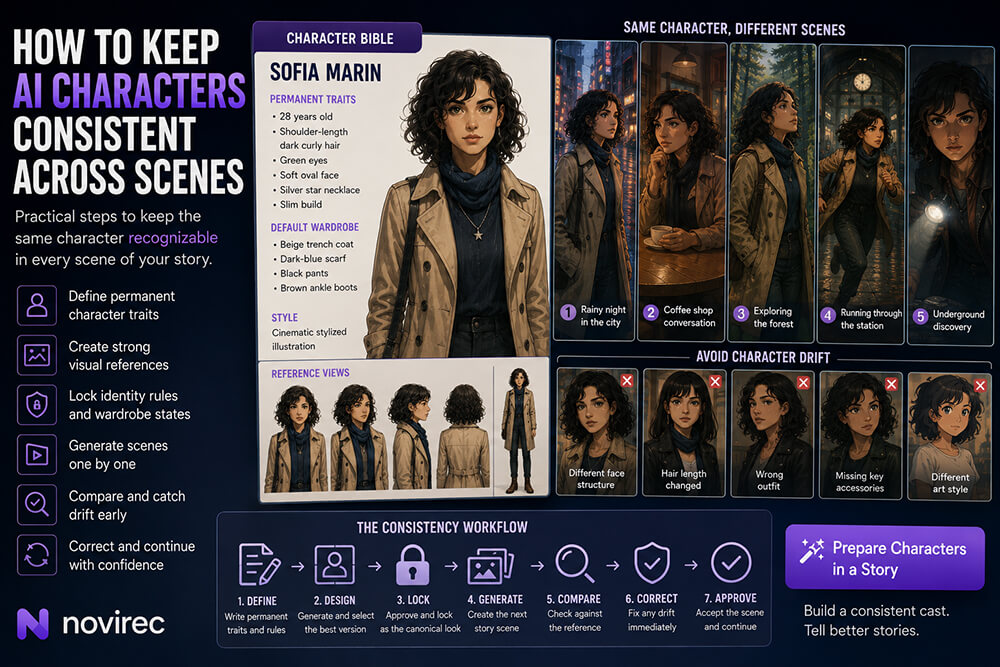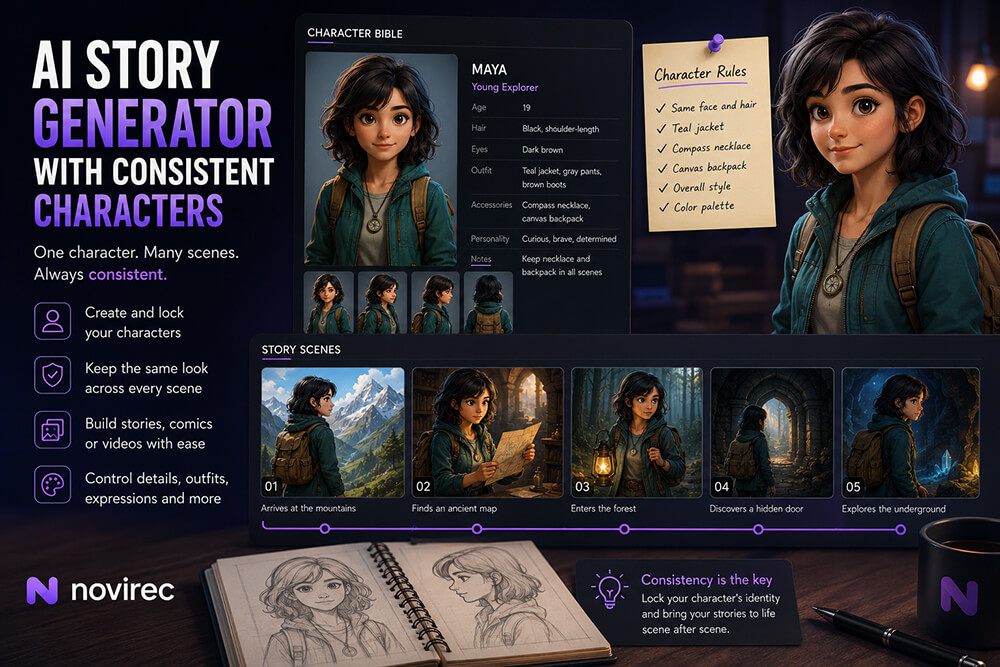

You create a protagonist for your AI story.
The first image looks perfect.
Then you generate the next scene.
The face changes.
Then the jacket changes.
Then the hairstyle.
By the fifth scene, your protagonist looks like a different person.
A Character Bible is designed to prevent exactly this problem.
Instead of asking an AI model to reinterpret a character from scratch every time, a Character Bible establishes a canonical identity before large-scale scene production begins.
It defines what the character looks like, which details should remain stable, what can change, and which visual references future scenes should follow.
In Novirec, the Character Bible is part of the Stories workflow before scene production and acts as the canonical visual reference for appearance, outfit, palette and continuity.
Create a Story with Novirec and prepare your recurring characters before building the complete scene sequence.
What Is an AI Character Bible?
An AI Character Bible is a structured definition of a recurring character used throughout an AI-generated visual story.
Think of it as the character’s source of truth.
It may contain:
- approved visual reference;
- facial appearance;
- hairstyle;
- age;
- body proportions;
- clothing;
- accessories;
- color palette;
- distinguishing features;
- alternate views;
- allowed variations;
- story-state changes;
- continuity rules.
The Character Bible answers a simple question:
When this character appears again, what should remain recognizable?
Without that definition, every new generation can become another interpretation of the same written description.
Why Is It Called a “Bible”?
In traditional film, animation, television and game production, teams often maintain reference documents that define characters and worlds.
The purpose is consistency.
If twenty artists work on the same character, they need to know:
- how tall the character is;
- what they wear;
- how their hair looks;
- which colors belong to them;
- what their personality is;
- what visual details should never change.
AI storytelling creates a similar problem.
Except instead of coordinating twenty artists, you may be coordinating:
- several image generations;
- multiple AI models;
- scene edits;
- image-to-video generations;
- comic panels;
- different camera angles.
The Character Bible gives those generations a shared visual target.
Character Bible vs Character Prompt
These are related, but they are not the same thing.
A character prompt is usually a text description.
For example:
Elena, 26 years old, shoulder-length black hair, green eyes, red coat.
That is useful.
But it still leaves enormous room for interpretation.
What shape is Elena’s face?
How long exactly is the coat?
What shade of red?
Does she wear boots?
What happens when she is seen from the side?
A Character Bible goes further.
It combines written rules with an approved visual identity.
| Character Prompt | Character Bible |
|---|---|
| Primarily text | Text + visual references |
| Describes possibilities | Establishes an approved identity |
| May vary between generations | Designed for reuse |
| Often scene-specific | Project-level reference |
| Easy to rewrite accidentally | Stable continuity source |
| Limited visual precision | More visual information |
A prompt tells the AI:
“Create someone like this.”
A Character Bible says:
“This is the character.”
Character Bible vs Character Sheet
A character sheet is usually a collection of views or drawings.
It may contain:
- front view;
- side view;
- rear view;
- expressions;
- poses.
That can be extremely useful.
But a Character Bible can contain more than imagery.
It may also define:
- wardrobe rules;
- palette;
- important accessories;
- story-state changes;
- consistency requirements;
- when appearance changes are allowed.
A character sheet is therefore often part of a Character Bible rather than a complete replacement for it.
Character Bible vs Reference Image
A single reference image can be very powerful.
But it only shows one moment.
Suppose the reference is:
close-up portrait of Elena.
You may see her face clearly.
But you cannot see:
- shoes;
- coat length;
- backpack;
- body proportions;
- rear hairstyle;
- full silhouette.
A Character Bible can combine multiple pieces of information.
For example:
Primary portrait
Face and hairstyle.
Full-body reference
Clothing and proportions.
Profile
Side facial structure.
Written rules
Accessories, palette and permanent features.
The objective is not to collect endless references.
It is to reduce ambiguity.
What Should an AI Character Bible Contain?
The exact structure depends on the project, but a practical Character Bible usually contains several layers.
1. Basic identity
Start with simple information.
Name: Elena Voss
Age: 26
Role: Archaeologist
Build: Slim, medium height
This is useful for organization.
But these details alone do not define her visually.
2. Facial identity
Describe the main facial features that should remain recognizable.
For example:
- oval face;
- green eyes;
- straight nose;
- dark eyebrows;
- light freckles;
- small scar above left eyebrow.
Do not try to describe every millimeter.
Focus on characteristics that make the face recognizable.
3. Hairstyle
Hair is one of the strongest identity cues.
Define:
- color;
- length;
- texture;
- hairstyle;
- fringe/bangs;
- parting.
For Elena:
Shoulder-length straight black hair, center part, slightly tucked behind the ears.
If later scenes randomly produce:
- long curls;
- short bob;
- blond hair;
the inconsistency becomes immediately visible.
4. Body and silhouette
Not every project requires exact body measurements.
But broad proportions matter.
For example:
Slim athletic build, approximately medium height, narrow shoulders.
This is especially useful for:
- full-body scenes;
- comics;
- action shots;
- rear views;
- wide compositions.
A character who changes dramatically in height or build between scenes may feel inconsistent even when the face is reasonably similar.
5. Default Wardrobe
Clothing is one of the strongest visual continuity anchors.
For example:
Jacket: dark red field jacket
Shirt: charcoal gray
Trousers: black cargo trousers
Shoes: brown hiking boots
Now future scenes know the default outfit.
This does not mean the character can never change clothes.
It means changes should be intentional.
6. Signature Accessories
Distinctive accessories make characters easier to recognize.
Examples include:
- glasses;
- necklace;
- watch;
- scarf;
- backpack;
- earrings;
- hat;
- bracelet;
- weapon;
- tool.
For Elena:
Small brass compass necklace.
That object may even become part of the story.
If it is visually important, the Character Bible should say so.
7. Color Palette
A character palette can help preserve visual identity even across different lighting conditions.
For example:
Primary: deep burgundy
Secondary: charcoal
Accent: brass
Hair: black
Eyes: green
These colors can become recognizable visual shorthand.
Imagine a comic where the protagonist appears small in a distant panel.
The face may barely be visible.
But the combination:
burgundy jacket + black hair + brass accessory
can still communicate identity.
8. Canonical Visual Reference
This is one of the most important components.
The canonical reference is the approved visual interpretation of the character.
Not:
“one possible Elena.”
But:
“This is Elena.”
Choose carefully.
The reference should ideally show:
- clear face;
- correct hairstyle;
- correct age;
- intended visual style;
- useful wardrobe information;
- recognizable colors.
Once approved, future scenes should be compared against it.
Novirec describes its Character Bible specifically as a canonical visual reference, with appearance, outfit, palette and continuity established before scene creation.
9. Additional Reference Views
A front-facing portrait cannot solve every camera angle.
For an important protagonist, additional views can help.
Useful options include:
Front
Strong facial reference.
Three-quarter
Useful natural storytelling angle.
Profile
Clarifies side facial structure.
Full body
Shows wardrobe and proportions.
Rear view
Useful if hairstyle or backpack matters.
You do not need twenty images.
Use only references that reduce a real ambiguity.
10. Visual Style
The same character can look completely different in different artistic styles.
For example:
- photorealistic;
- Pixar-like 3D;
- watercolor;
- anime;
- graphic novel;
- cinematic illustration;
- flat cartoon.
A Character Bible should belong to the broader visual direction of the story.
For example:
Stylized cinematic adventure illustration with realistic lighting and slightly simplified facial features.
Now the character and the story world share the same visual language.
Permanent Traits vs Variable Traits
This distinction is essential.
A Character Bible should not freeze everything forever.
Some characteristics define identity.
Others should change according to the story.
Permanent traits
Usually stable:
- face;
- eye color;
- natural hair color;
- approximate age;
- body proportions;
- important identifying marks.
Variable traits
Can change:
- clothing;
- injuries;
- dirt;
- hairstyle arrangement;
- weather effects;
- equipment;
- emotional expression.
The key is to define why and when something changes.
Story States Make Character Bibles More Powerful
Imagine Elena begins the story wearing her normal expedition clothes.
Later, she survives a cave collapse.
Her appearance should change.
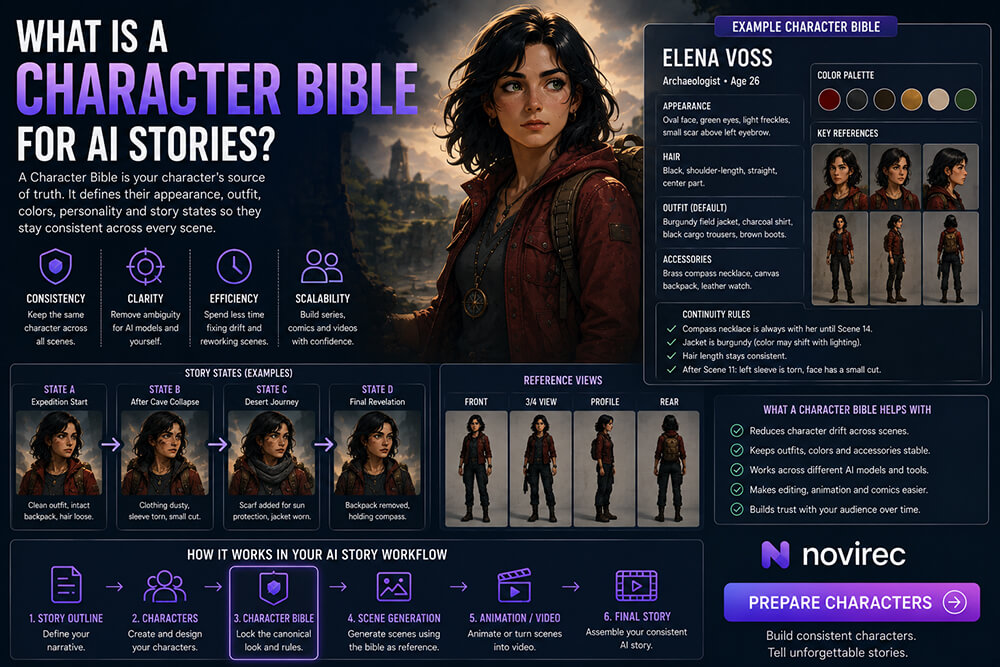
You can define multiple story states.
State A — Expedition Start
- clean burgundy jacket;
- intact backpack;
- compass necklace;
- hair loose.
State B — After the Cave Collapse
- same jacket;
- torn left sleeve;
- dust on clothing;
- small cut on cheek;
- backpack strap damaged.
State C — Final Temple Scene
- jacket still damaged;
- backpack removed;
- compass held in hand.
This is not character drift.
It is continuity.
The Character Bible helps distinguish intended progression from accidental generation changes.
A Character Bible Is Not Only About the Face
One of the biggest misconceptions about AI character consistency is that it means:
“Make the face identical.”
The face matters.
But storytelling identity also comes from:
- silhouette;
- clothing;
- colors;
- accessories;
- body proportions;
- hairstyle;
- visual style.
Consider a rear view.
You cannot see the character’s face at all.
Yet the audience should still recognize them.
They may recognize:
- the burgundy jacket;
- backpack;
- hairstyle;
- height;
- compass chain.
A strong Character Bible therefore defines the whole character.
Why Character Bibles Matter More in Multi-Scene Stories
If you generate one image, consistency is irrelevant.
There is nothing to compare it against.
With two scenes, variation starts to matter.
With twenty scenes, it becomes critical.
A multi-scene AI story may contain:
- close-ups;
- wide shots;
- different environments;
- different lighting;
- new poses;
- action;
- dialogue;
- video animation.
Every generation creates another opportunity for reinterpretation.
The Character Bible gives those scenes a stable visual reference.
Character Bibles for Illustrated Stories
Illustrated stories make visual inconsistency easy to notice because readers can spend several seconds looking at each image.
Imagine a children’s story where the protagonist is a small fox.
Page 1:
orange fur, blue scarf, white chest.
Page 3:
darker fur, green scarf.
Page 6:
no white chest.
The reader may wonder whether this is another fox.
A simple Character Bible could define:
Species: red fox
Fur: bright orange
Chest: white
Scarf: blue
Eyes: green
Tail tip: white
That small amount of preparation can dramatically improve readability.
Character Bibles for AI Comics
Comics make inconsistency even more visible because multiple versions of the same character can appear on the same page.
For example:
Panel 1
Elena speaks to another character.
Panel 2
Close-up of Elena.
Panel 3
Elena turns away.
Panel 4
Wide shot.
The viewer compares all four immediately.
The Character Bible helps maintain:
- same facial identity;
- wardrobe;
- palette;
- accessories;
- silhouette.
And because the comic may show many angles, multiple useful reference views can become especially valuable.
Character Bibles for AI Video Stories
Video adds another challenge.
The character must remain recognizable:
- within a clip;
- between clips;
- across different camera angles.
A practical video-story workflow can be:
Character Bible
↓
Scene image
↓
Scene approval
↓
Image-to-video
↓
Final sequence
Instead of asking the video model to reinvent the protagonist from text for every shot, the Character Bible informs the visual scene before animation.
This reduces the number of creative variables being solved simultaneously.
Can You Have a Character Bible for Non-Human Characters?
Absolutely.
A Character Bible can define:
- animals;
- robots;
- monsters;
- mascots;
- fantasy creatures;
- aliens;
- vehicles with personality.
For example:
Robot Character
Body: small rounded white shell
Eyes: two circular cyan displays
Chest: orange rectangular panel
Antenna: one flexible antenna on left side
Damage: long scratch on right casing
Height: approximately knee-high to an adult
Those rules make the robot recognizable across scenes.
How Many Characters Need a Character Bible?
Not everyone.
Use effort according to importance.
Main characters
Yes.
They appear repeatedly and deserve strong references.
Recurring secondary characters
Usually yes.
Especially if they interact with the protagonist across many scenes.
Minor characters
A simplified definition may be enough.
Background extras
Usually no Character Bible is required.
This avoids unnecessary complexity.
Your goal is not to document every person who appears in one frame.
It is to protect the identities that matter to the story.
How Detailed Should a Character Bible Be?
Enough to remove important ambiguity.
Not so much that it becomes impossible to maintain.
A useful Character Bible may contain:
- 5–10 meaningful visual traits;
- one primary reference;
- perhaps a few complementary views;
- wardrobe;
- important accessory;
- palette;
- story-state rules.
Hundreds of tiny details are usually unnecessary.
Focus on what the audience notices.
Example AI Character Bible
Here is a compact example.
ELENA VOSS
Role: Archaeologist and protagonist
Age: 26
Build: Slim, medium height
Face
- oval face;
- green eyes;
- dark eyebrows;
- light freckles;
- small scar above left eyebrow.
Hair
- black;
- shoulder length;
- straight;
- center part.
Default outfit
- burgundy field jacket;
- charcoal shirt;
- black cargo trousers;
- brown boots.
Accessories
- brass compass necklace;
- dark canvas backpack.
Palette
- burgundy;
- charcoal;
- brass;
- dark brown.
Visual style
Cinematic stylized adventure illustration.
Canonical reference
Approved three-quarter portrait with full outfit visible.
Continuity rules
- compass necklace stays with Elena until scene 14;
- jacket remains burgundy;
- hair remains shoulder length;
- backpack is lost in scene 9;
- left jacket sleeve becomes torn after scene 11.
That is already enough to establish a strong production reference.
How to Build an AI Character Bible Step by Step
Step 1 — Write the essential character description
Start with the broad identity.
Who are they?
How old are they?
What visual elements matter?
Avoid overcomplicating the first draft.
Step 2 — Identify the strongest visual anchors
Choose the features that make this character recognizable.
For example:
- hairstyle;
- jacket;
- eye color;
- signature accessory.
If you removed everything else, would the character still be recognizable?
Those are your strongest anchors.
Step 3 — Generate the initial visual design
Create several possible interpretations.
At this stage, exploration is fine.
You are not yet trying to preserve consistency.
You are choosing the identity that deserves to become consistent.
Step 4 — Select one canonical version
Do not keep changing direction forever.
Pick the strongest version.
Ask:
- Does the face fit the character?
- Is the age right?
- Does the style fit the story?
- Is the outfit distinctive enough?
- Can this design work across many scenes?
Once approved, this becomes the reference.
Step 5 — Add useful supplementary views
If required, create:
- profile;
- full-body;
- rear view.
Make sure those references still represent the same approved design.
Do not accidentally create three competing interpretations.
Step 6 — Define wardrobe and palette
Write down the stable clothing and major colors.
This is especially useful when scenes contain different lighting.
A red jacket should not randomly become orange simply because sunset lighting is strong.
Step 7 — Define continuity rules
Ask what may change during the story.
Examples:
- outfit change;
- injury;
- lost object;
- new equipment;
- damaged clothing.
Record when these changes occur.
Use the Character Bible Before Scene Generation
The best time to discover that the protagonist is wrong is:
before generating 20 scenes.
A structured workflow therefore looks like:
Story concept
↓
Character design
↓
Character Bible approved
↓
Scenes
↓
Final visual format
This is also how Novirec positions its current Stories flow: Brief → Outline → Characters → Scenes → Editor, with character identity prepared before scene production.
That ordering is important.
What Happens Without a Character Bible?
Suppose you generate ten scenes manually.
Scene 1:
curly black hair.
Scene 2:
black wavy hair.
Scene 3:
long black hair.
Scene 4:
shoulder-length dark hair.
The descriptions sound similar to a human.
But the visual interpretation can drift.
Then:
- the face changes;
- jacket becomes another color;
- necklace disappears;
- age changes slightly.
Each individual image may be excellent.
Together, the story feels inconsistent.
A Character Bible reduces the number of decisions that need to be reinvented for every scene.
Character Bible and Multi-Reference AI
Reference images become even more useful when a workflow supports multiple visual inputs.
One reference might communicate:
- face.
Another:
- full outfit.
Another:
- style.
Novirec currently supports ordered multi-reference image workflows and positions them around preserving characters, clothing, style, products and scene continuity.
The Character Bible helps decide which references are authoritative.
Without that structure, multiple references can simply create more ambiguity.
Avoid Conflicting References
More references are not always better.
Suppose:
Reference 1
Elena has short black hair.
Reference 2
Elena has shoulder-length hair.
Reference 3
Elena wears a different jacket.
Which version is correct?
The model now receives contradictory information.
Every additional reference should clarify the canonical identity, not challenge it.
Character Bible and Different AI Models
A visual story may use different AI models for different tasks.
For example:
- one image model for initial design;
- another for editing;
- another for complex scenes;
- a video model for animation.
Without an external source of truth, each model may reinterpret the character differently.
The Character Bible provides a reusable identity independent of any single generation.
That makes it especially useful in multi-model production workflows.
Character Bible vs Seed
Seeds can sometimes help reproduce aspects of a generation within specific workflows.
But a seed is not a complete character identity system.
It does not clearly describe:
- outfit;
- accessories;
- allowed story changes;
- alternate camera views;
- continuity state.
A Character Bible is conceptually broader.
It represents what the character is, not merely one technical generation state.
Character Bible vs Face Reference
A face reference solves one specific problem:
facial identity.
A Character Bible solves:
story identity.
The difference matters.
Suppose the face stays perfect but:
- clothes change;
- backpack disappears;
- height changes;
- hairstyle changes;
- art style changes.
The character is still visually inconsistent.
Face identity is one component of continuity, not the entire system.
Character Bible vs LoRA or Character Model
Training a dedicated character model or LoRA can provide another approach to recurring character generation.
But it involves different tradeoffs:
- training data;
- preparation;
- model compatibility;
- time;
- technical complexity.
A Character Bible is a workflow-level concept.
It can exist regardless of whether the underlying generation uses:
- references;
- model-specific consistency features;
- editing;
- fine-tuning;
- multiple models.
That makes it more flexible as a production system.
Does a Character Bible Guarantee Perfect Consistency?
No.
AI generation remains probabilistic.
A Character Bible improves the information available to the workflow.
It does not transform a generative model into a fixed 3D character rig.
You still need to review outputs.
The practical objective is:
reduce unwanted visual drift and catch it before it spreads.
For example:
Scene 6 produces the wrong jacket.
Do not continue to scene 7 using that incorrect version.
Correct scene 6.
Approve it.
Then continue.
The Character Bible gives you something objective to compare against.
How to Review a Scene Against the Character Bible
Use a short checklist.
Identity
Does this clearly look like the approved character?
Face
Do the major facial characteristics match?
Hair
Correct color, length and shape?
Wardrobe
Correct for the current story state?
Accessories
Should they still be present?
Palette
Are the main colors correct?
Proportions
Does the body remain recognizable?
Style
Does the character belong to the same visual world?
Continuity
Are any changes intentional?
This process should be quick.
You are not conducting a forensic examination.
You are preventing obvious drift.
Character Bibles Can Evolve During the Story
A Character Bible should be stable but not inflexible.
Suppose your protagonist undergoes a major transformation.
That may become a new canonical state.
For example:
Elena V1
Explorer outfit.
Elena V2
Ceremonial temple clothing.
Elena V3
Post-battle damaged version.
Each version still represents Elena.
The permanent identity remains.
The story state evolves.
This is much cleaner than allowing random appearance changes in every scene.
Character Bibles Can Improve Collaboration
Even if one person creates the entire project, the Character Bible improves organization.
With a team, it becomes even more valuable.
A writer, image artist, editor and animator can all refer to the same specification.
Instead of asking:
“Which red jacket did we use?”
the answer already exists.
That makes the Character Bible useful beyond AI generation itself.
Character Bible for a Series
The concept becomes even more valuable if a character appears across multiple stories.
Imagine:
Story 1
Elena and the Lost Temple.
Story 2
Elena and the Frozen Observatory.
Story 3
Elena and the Underground Sea.
If you rebuild Elena from scratch each time, her identity may change between stories.
A reusable Character Bible gives the entire series a stable cast.
This can be useful for:
- recurring YouTube series;
- children’s characters;
- web comics;
- mascots;
- serialized fiction;
- educational characters.
Character Bible for Brand Mascots
The same concept works outside traditional fiction.
Suppose a company has a recurring mascot.
A Character Bible can define:
- body shape;
- colors;
- expression style;
- clothing;
- logo placement;
- proportions.
Now marketing images, explainers and videos can reuse a more stable visual identity.
The principle remains the same:
repeated visual character → reusable identity definition.
How Long Does It Take to Prepare a Character Bible?
A simple Character Bible does not need to take hours.
For an important protagonist, the main work is usually:
- decide the design;
- generate possible versions;
- select the best one;
- create useful references;
- define stable traits and rules.
The biggest time investment is often choosing the character you actually want.
Once the design is approved, the Bible can save time throughout the rest of the project by reducing repeated experimentation.
Is a Character Bible Worth It for a Short Story?
It depends on repetition.
A four-scene story with one recurring protagonist can already benefit.
A single-image project probably does not need one.
Use this simple rule:
The more times the same character appears, the more valuable a Character Bible becomes.
For:
- 1 image → probably unnecessary.
- 3 scenes → useful.
- 10 scenes → strongly recommended.
- 30 comic panels → extremely useful.
- recurring series → foundational.
Common Character Bible Mistakes
Trying to lock every tiny detail
Focus on recognizable characteristics.
Using weak visual references
Choose references where important details are visible.
Keeping several incompatible “canonical” versions
Select one approved identity.
Forgetting wardrobe
Clothing is a major recognition cue.
Ignoring accessories
Signature items can matter as much as faces.
Treating intentional story changes as errors
Use story states.
Never updating the Bible
Major intentional transformations should be recorded.
Assuming the Bible eliminates review
Generative variation can still happen.
Defining only the face
Identity extends to the whole character.
Creating the Bible after all scenes are generated
Prepare important characters early.
AI Character Bible Checklist
Before approving a recurring character, verify:
- Character name and role defined
- Approximate age correct
- Face approved
- Hairstyle approved
- Body/silhouette appropriate
- Default outfit defined
- Important accessories defined
- Main color palette established
- Canonical visual reference selected
- Additional views created if necessary
- Art style consistent with project
- Permanent traits separated from variable traits
- Story-state changes documented
- Conflicting references removed
If those points are clear, you have a strong foundation for multi-scene generation.
Frequently Asked Questions
What is a Character Bible in AI storytelling?
A Character Bible is a structured visual and written reference that defines a recurring character’s approved identity, including appearance, wardrobe, palette, references and continuity rules.
Why do I need a Character Bible for AI-generated stories?
Because each new AI generation can reinterpret a character. A Character Bible gives recurring scenes a stable visual target and helps identify unwanted character drift.
Is a Character Bible the same as a prompt?
No. A prompt is primarily an instruction for a generation. A Character Bible is a reusable project-level source of truth containing the approved character design and continuity rules.
How many reference images should a Character Bible contain?
There is no fixed number. Use enough references to clearly establish the character without introducing conflicting versions. A primary approved image plus a few useful alternate views can often be enough.
Does a Character Bible guarantee the same character every time?
No. Generative models can still introduce variation. The Character Bible improves consistency and gives you a reference for reviewing and correcting scenes.
Can a Character Bible include different outfits?
Yes. You can define a default wardrobe and intentional alternate story states while keeping the character’s core identity stable.
Do I need a Character Bible for every character?
Usually not. Prioritize protagonists and recurring secondary characters. One-time background characters may only need a simple description.
Build the Character Before You Build the Story
The easiest way to lose character consistency is to generate dozens of scenes before deciding exactly who the character is.
A Character Bible reverses that process.
First:
Who is this character?
Then:
What do they look like?
Then:
Which details define their identity?
Then:
What is allowed to change during the story?
Only after those questions are resolved do you start asking:
What happens in the next scene?
That separation is powerful.
The character stops being something the AI reinvents every time.
It becomes a reusable part of the story.
And once your protagonist can move through different scenes, camera angles, outfits and environments while remaining recognizable, the entire visual narrative becomes easier to follow.
Create a Story with Novirec and prepare your recurring cast before generating the complete sequence of scenes.
New to the platform? Create your Novirec account and start building your first consistent visual story.
Ready to put this workflow into practice?
Open Novirec Studio and start creating with the same tools covered in this guide.