
Creating one great AI character is easy compared with making that same character appear consistently across an entire story.
Hair changes. Clothes shift color. Facial features drift. Accessories disappear. A character who looks 18 in one illustration may suddenly look 30 in the next.
For a standalone AI image, those variations may not matter.
For a story, they can destroy visual continuity.
An AI story generator with consistent characters therefore needs more than good image generation. It needs a workflow that establishes who each recurring character is before dozens of story scenes are created.
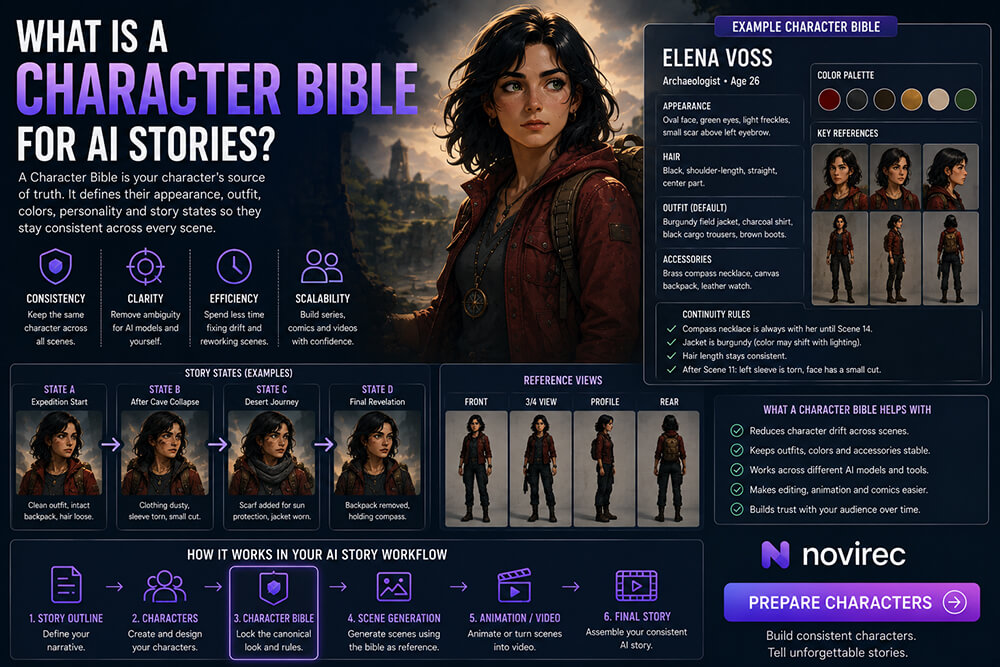
Novirec approaches visual storytelling this way: Stories move from the initial brief and outline into Characters, then Scenes, with a Character Bible used as the canonical visual reference before scene production.
Ready to build a recurring cast? Create a Story with Novirec and establish your characters before generating the full sequence.
Why Is Character Consistency So Difficult with AI?
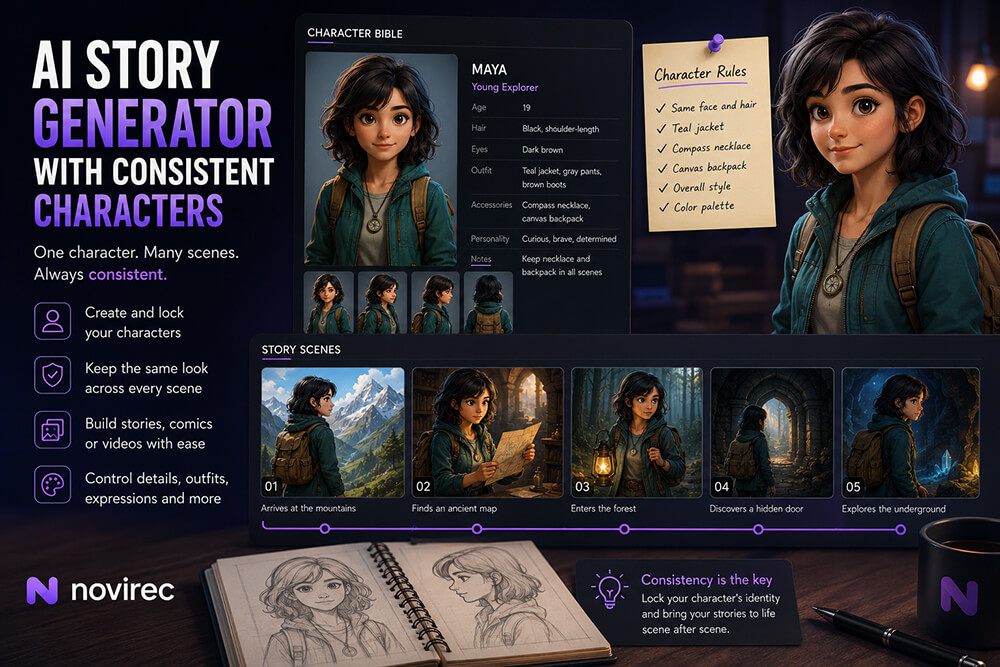
Imagine a character named Maya.
Her visual description is:
Maya is a young explorer with shoulder-length black hair, a teal jacket, brown hiking boots, a silver compass necklace and a small canvas backpack.
Generate one image and the result may be excellent.
Now generate ten different scenes.
You may see:
- shorter hair in scene two;
- a blue jacket in scene three;
- a missing necklace in scene four;
- a different face in scene five;
- a leather backpack in scene six;
- different body proportions later in the story.
The prompt still says “Maya.”
But an image model does not automatically understand Maya as a permanent actor with an immutable production design.
Each generation introduces opportunities for reinterpretation.
A visual storytelling workflow needs to reduce that reinterpretation by giving the recurring character stronger visual anchors.
What Does “Consistent Character” Actually Mean?
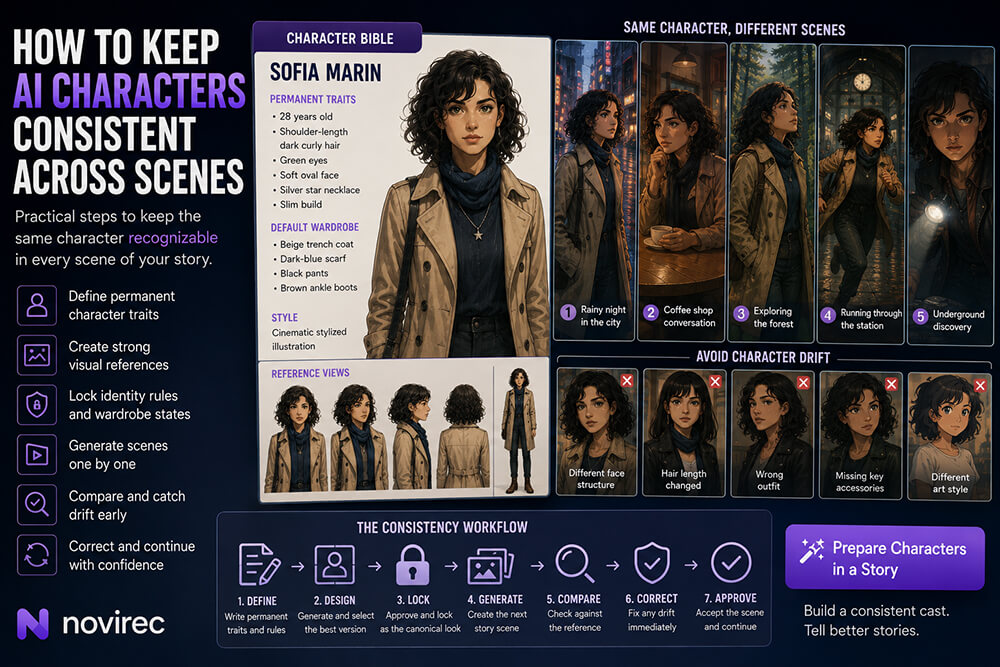
Character consistency is not only about the face.
A recurring story character has several layers of identity.
| Consistency area | What should remain stable |
|---|---|
| Face | Facial structure, eyes, nose, approximate age |
| Hair | Style, length, texture and color |
| Wardrobe | Main outfit, colors, footwear |
| Accessories | Glasses, necklace, hat, backpack, jewelry |
| Body design | Height, build and proportions |
| Visual style | Cartoon, realistic, watercolor, cinematic, etc. |
| Identity cues | Distinctive details that make the character recognizable |
Some elements can intentionally change.
A character may put on a coat because it starts raining.
They may receive a new outfit later in the story.
They may become dirty after an adventure.
That is not inconsistency.
Unexplained visual change is the problem.
The objective is not to freeze a character forever. It is to ensure that visual changes happen because the story requires them rather than because the AI randomly redesigned the character.
How Novirec Approaches Consistent Characters
Novirec Stories currently places character preparation before scene generation. Its public workflow is organized as Brief → Outline → Characters → Scenes → Editor, and its Character Bible establishes a canonical visual reference with appearance rules, outfit, palette and continuity information before scenes are produced.
Novirec also exposes multi-reference image workflows intended to preserve elements such as characters, style, clothing, products and scene continuity.
That architecture matters.
Instead of asking:
“Can the AI remember my character?”
the workflow asks:
“What visual information should every scene reuse when this character appears?”
That is a much stronger foundation for a multi-scene project.
Character Consistency Starts Before the First Story Scene
One of the most common mistakes in AI storytelling is generating the first ten scenes and only afterward realizing that the protagonist looks different in each one.
A better process is:
Story idea → Character definition → Visual reference → Approval → Scene generation
Before creating your full story, decide what the recurring character actually looks like.
For example:
Character
Name: Maya
Age: 19
Hair: Shoulder-length wavy black hair
Eyes: Dark brown
Main outfit: Teal outdoor jacket, charcoal trousers, brown hiking boots
Accessories: Silver compass necklace and tan canvas backpack
Visual style: Stylized cinematic animation
Important rule: Compass necklace should remain visible whenever her upper torso is visible.
This gives the character a reusable specification rather than a vague description.
Step 1 — Define the Character’s Essential Identity
Not every detail needs to be rigid.
Identify the features that actually make the character recognizable.
For a human character, that may be:
- hairstyle;
- face;
- approximate age;
- skin tone;
- body proportions;
- main clothing;
- signature accessories.
For an animal character:
- species;
- fur pattern;
- eye color;
- markings;
- collar or accessory;
- proportions.
For a robot:
- body shape;
- color scheme;
- screen or eye design;
- antenna;
- mechanical details;
- visible damage or markings.
Prioritize features a viewer will notice repeatedly.
If your character has fifteen tiny details that never appear clearly on screen, trying to preserve all fifteen may add complexity without improving recognition.
Step 2 — Create a Strong Character Reference
Text descriptions are useful.
A visual reference can provide much more information at once.
Instead of repeatedly describing:
oval face, large brown eyes, narrow nose, curly shoulder-length hair, teal jacket with brass zipper…
a reference image communicates those characteristics visually.
A useful character reference should make the important design elements easy to see.
Prefer:
- clear face visibility;
- neutral or useful lighting;
- unobstructed clothing;
- recognizable colors;
- limited motion blur;
- enough resolution to see identifying features.
Avoid using a reference where half the character is hidden if those hidden details will be important later.
Step 3 — Establish the Canonical Look
A story often contains many generated images.
You need one visual interpretation to become the reference version of the character.
This is essentially what the Character Bible is for.
The goal is to say:
“This is Maya.”
not:
“Here are six unrelated versions of what Maya might look like.”
Novirec publicly describes its Character Bible as the canonical visual reference used before scene production, including appearance, outfit and palette rules.
Once that visual identity is approved, subsequent scenes have a much clearer target.
Step 4 — Separate Character Identity from Scene Information
Do not force the character prompt to describe the entire story every time.
Character identity and scene information serve different purposes.
Character identity
Maya, 19, shoulder-length black hair, teal hiking jacket, silver compass necklace, tan backpack.
Scene information
Maya stands at the entrance of an abandoned underground station, shining a flashlight into the darkness.
The character information establishes who appears.
The scene information establishes what is happening now.
Keeping those concepts separate makes a multi-scene project easier to reason about and revise.
Step 5 — Generate Scenes Around the Approved Character
Now the story can move through different situations.
Scene 1
Maya arrives at a mountain village.
Scene 2
Maya discovers a map inside an old book.
Scene 3
Maya enters a forest.
Scene 4
Maya finds a stone doorway.
Scene 5
Maya explores an underground tunnel.
The background, lighting, pose and emotion can all change.
Maya’s identity should not.
This distinction is crucial.
Consistency does not mean every image looks identical.
It means the viewer still believes the same actor is moving through different moments of the story.
Consistency vs Repetition
There is an important difference between making a character consistent and making every illustration repetitive.
A consistent story can still contain:
- different expressions;
- different poses;
- different camera angles;
- different lighting;
- close-ups and wide shots;
- action scenes;
- quiet emotional moments;
- different environments.
You do not want ten copies of the same portrait.
You want ten different story moments starring the same recognizable character.
Camera Angles Can Make Consistency Harder
Some views naturally reveal less identifying information.
A front-facing close-up may show the character perfectly.
A distant rear shot may show almost none of the face.
A dramatic side angle can change the perceived facial structure.
That does not necessarily mean the character is inconsistent.
Evaluate the features that should logically be visible in each shot.
For a rear view, you might prioritize:
- hairstyle;
- outfit;
- backpack;
- silhouette.
For a close-up:
- face;
- eyes;
- hairstyle;
- signature accessory.
For a wide shot:
- overall proportions;
- wardrobe colors;
- recognizable silhouette.
Consistency should be judged according to the composition.
Clothing Continuity Is Part of Storytelling
Wardrobe drift is one of the easiest ways to break a visual story.
Imagine your protagonist is wearing:
- a red hoodie;
- black trousers;
- white sneakers.
If scene two suddenly gives them a leather jacket, viewers may assume time has passed or the character changed clothes.
If the story never establishes that change, the scene creates confusion.
For recurring characters, decide whether an outfit is:
Locked
The character keeps it across a sequence.
Scene-specific
The outfit deliberately changes for a specific part of the story.
Progressive
The outfit evolves because of events, such as becoming wet, dirty, damaged or adding equipment.
The important element is intentionality.
Accessories Are Powerful Identity Anchors
Accessories can make a character easier to recognize.
Examples include:
- glasses;
- a specific necklace;
- hat;
- scarf;
- backpack;
- sword;
- bracelet;
- unusual earrings;
- robot attachment.
These details can act like visual signatures.
Consider a fantasy protagonist with a bright blue crystal pendant.
Even in a scene where the face is small, the pendant can reinforce identity.
But if the pendant is important, you also need to check that it does not randomly disappear between shots.
Character Consistency in Illustrated Stories
Illustrated stories give viewers time to inspect each image.
This means inconsistencies can be particularly noticeable.
The reader may spend several seconds looking at a single page.
They can compare:
- faces;
- outfits;
- props;
- backgrounds;
- character proportions.
For illustrated storytelling, prioritize clean visual references and deliberate scene approval before moving forward.
Novirec presents Illustrated Story as one of its current AI Stories formats, centered on narrative pages with a primary illustration and written storytelling.
Character Consistency in AI Comics
Comics introduce another challenge.
The same character may appear several times on the same page.
A panel sequence might show:
- close-up of Maya looking surprised;
- Maya turning around;
- Maya running down a corridor;
- Maya opening a door.
If her clothing or face changes between panels, the discrepancy becomes immediately obvious.
At the same time, comics benefit from strong recurring visual shorthand.
Readers quickly learn:
- hairstyle;
- silhouette;
- colors;
- accessories.
That makes a solid character design especially valuable.
Novirec currently includes Comic Story as a Stories format with panels, dialogue, speech bubbles, captions and page layouts.
Consistent Characters in AI Video Stories
Video adds another layer.
Now the character must remain recognizable not only between scenes, but also during motion.
An approved still image can provide a useful visual foundation before animation.
The general workflow becomes:
Character → Scene image → Approval → Motion
rather than:
Text prompt → Random video → Hope the character matches
Novirec currently describes its Video Story format as using approved scenes prepared for animation, audio and final video assembly.
For a multi-scene project, this allows visual issues to be caught before they become video-generation issues.
What Else Needs to Stay Consistent?
Characters receive most of the attention, but they are only one continuity problem.
A story also has:
Locations
If the hero’s bedroom has a window on the left in scene one and suddenly has two windows on the opposite wall in scene four, the room may feel different.
Props
A magic book, phone, backpack, vehicle or weapon should persist when the story says it does.
Time
Sunrise should not become midnight between two continuous scenes.
Weather
Heavy rain should not disappear without explanation.
Style
Characters may technically be recognizable while the story shifts from cinematic realism to watercolor to 3D cartoon.
Visual storytelling benefits from continuity at the world level, not only the character level.
How to Review Character Consistency Scene by Scene
Before approving a scene, perform a quick visual check.
Identity
Does this clearly look like the established character?
Hair
Is style, length and color correct?
Face
Are the main identifying features recognizable?
Clothing
Is the correct outfit being used?
Accessories
Are important items present?
Age
Has the perceived age changed unexpectedly?
Proportions
Does the body still match the character?
Style
Does the character belong to the same visual universe?
Story logic
Should anything deliberately look different in this scene?
A short approval process can prevent errors from propagating into later parts of the project.
What If the Character Changes Too Much?
Do not necessarily rebuild the whole story.
First identify what drifted.
If the face is wrong but everything else is correct, focus the correction on identity.
If clothing changed, reinforce wardrobe.
If the style drifted, restore the project’s visual direction.
If too many things changed simultaneously, returning to a stronger approved reference may be more effective than continually modifying a weak generation.
The key is diagnosing which continuity rule failed.
Text Description Alone vs Visual References
Text can establish a character concept.
Visual references can establish the character’s actual appearance.
A useful way to think about it is:
Text says what the character should be.
Reference images show what the character should look like.
For story projects, combining both gives the workflow more information than repeatedly using a name and short prompt alone.
Novirec’s broader image workflow includes ordered multi-reference editing, which the platform specifically positions for preserving characters, style, clothing and scene continuity.
Can You Have Multiple Consistent Characters?
Yes, but complexity increases as the cast grows.
A scene containing one recurring protagonist is easier to control than a scene containing four recurring characters.
For each major character, define a separate identity.
For example:
Maya
Teal jacket, black hair, silver compass.
Leo
Short blond hair, orange vest, round glasses.
Dr. Vale
Gray hair, long burgundy coat, black gloves.
When a scene contains Maya and Leo, both identities need to survive simultaneously.
This is where clear references become even more valuable.
Avoid Making Characters Too Similar
Character consistency becomes easier for the audience when the cast has distinct visual identities.
If four characters all have:
- similar hairstyles;
- similar clothes;
- similar colors;
- similar age;
- similar silhouettes;
even perfectly generated images may be harder to read.
Distinctive character design helps both storytelling and recognition.
You might intentionally vary:
- silhouette;
- height;
- hairstyle;
- dominant color;
- clothing style;
- accessories.
This makes the cast visually legible.
Should Every Character Have a Character Bible?
Not necessarily.
Focus effort on recurring characters.
A person who appears once in a crowd probably does not need the same level of preparation as the protagonist.
A useful hierarchy is:
Primary characters
High consistency priority.
Recurring secondary characters
Moderate to high priority.
Minor characters
Basic description may be sufficient.
Background characters
Usually scene-specific.
Put the strongest identity controls where they actually affect the story.
How Much Does a Consistent AI Story Cost?
Character consistency itself is not a single generation.
A complete story may involve character preparation, reference images, scene creation, corrections and possibly video animation.
That means total generation usage depends on factors such as:
- number of characters;
- number of scenes;
- how many versions are generated;
- selected image or video models;
- editing requirements;
- resolution;
- animation duration.
For visitors comparing options before joining, see Novirec pricing.
Existing users who need additional credits or want to manage their plan can view plans and credits inside Studio.
Common Character Consistency Mistakes
Generating the whole story before approving the character
Fix the design first.
Changing the description between scenes
Keep permanent characteristics stable.
Using weak references
Choose images where identifying details are clear.
Trying to control too many meaningless details
Prioritize what makes the character recognizable.
Confusing consistency with identical poses
Allow natural variation in expression, framing and action.
Ignoring wardrobe
Clothing is often one of the strongest identity cues in a visual story.
Forgetting accessories
Signature objects can be just as important as facial details.
Ignoring scene continuity
A consistent character inside an inconsistent world still creates a visually inconsistent story.
AI Story Generator with Consistent Characters vs Separate AI Tools
It is possible to build a visual story by combining separate tools.
You might:
- write the story somewhere;
- create character references in an image generator;
- save prompts manually;
- generate every scene individually;
- organize assets in folders;
- animate scenes elsewhere;
- manually track which character reference belongs where.
For experienced creators, that can work.
The difficulty increases as the project grows.
A dedicated story workflow instead treats characters, scenes and the final story as parts of the same project.
Novirec currently combines image generation, video generation, multi-reference editing and AI Stories within the same platform.
That does not eliminate the need for creative decisions.
It reduces the number of those decisions that must be reconstructed manually for every generation.
Who Benefits Most from Consistent AI Characters?
Character consistency matters particularly for:
- illustrated story creators;
- comic creators;
- AI filmmakers;
- children’s story creators;
- recurring social-media characters;
- educational narratives;
- fantasy stories;
- serialized content;
- branded mascots;
- creators building a reusable fictional cast.
If you create only one image of a character, consistency is not much of a problem.
If the same character appears twenty times, it becomes one of the central production problems.
Frequently Asked Questions
What is an AI story generator with consistent characters?
It is an AI storytelling workflow designed to reuse a recurring character’s visual identity across multiple scenes rather than treating every generated image as an unrelated creation.
Can AI really keep the same character in every image?
AI character consistency can be improved substantially through stable character definitions, strong visual references and controlled generation workflows, but generative variation can still occur. Human review remains useful for multi-scene projects.
What is a Character Bible?
A Character Bible is a reusable definition of a recurring character. In Novirec’s current Stories workflow, it acts as the canonical visual reference and includes appearance, outfit, palette and continuity information before scene production.
Should I create my character before generating story scenes?
For recurring characters, this is generally the more controlled approach. Establishing and approving the character first gives later scenes a clear visual reference.
Can I use more than one reference image?
Multi-reference workflows can provide additional visual information about a character, outfit or style. Novirec currently supports ordered multi-reference image workflows as part of its image creation and editing capabilities.
Does character consistency work for comics?
It is particularly important for comics because the same character may appear several times across adjacent panels. Novirec currently offers Comic Story as one of its AI Stories formats.
Can consistent characters be animated?
Approved visual scenes can provide a foundation for animation in a video-story workflow. Novirec’s current Video Story format is designed around approved scenes prepared for animation and final video assembly.
Create an AI Story with Consistent Characters
The hardest part of AI storytelling is often not creating a beautiful character.
It is keeping that character recognizable through the second, fifth and twentieth scene.
Treat your recurring cast as permanent parts of the project.
Define them.
Create strong references.
Approve their visual identity.
Then build the story around those established characters instead of asking the AI to reinvent them every time.
Novirec Stories is designed around that structured progression from story idea to characters, scenes and final visual format.
Create a Story with Novirec and start building your recurring characters before generating the full story.
New to Novirec? Create your account and begin your first visual storytelling project.
Ready to put this workflow into practice?
Open Novirec Studio and start creating with the same tools covered in this guide.